My Resolve: Supporting Women of Color in Education

Click for photo credit
As I previously wrote, I am the white woman I am today because of women of color. One of the primary reasons for this is that I was raised in countries and cultures that valued, honored and actively sought to put women of color in leadership positions, particularly in the church and in community organizations. As a young woman, I thought this was typical but as an adult I understand every place has a unique set of cultural values and norms. When I think about changing the culture of places that don’t value the voices of women, specifically women of color, I am reminded that cultures are dynamic. Although it feels easier said than done, cultures can change through the interactions of people, their ideas, their stories, and even through their conflicts.
While only 18% of teachers in the US are teachers of color, I maintain hope, that we are making some progress to include more diverse voices in teaching. In Washington state, our Professional Educator Standards boards is developing “Grow your Own” pathways. There are programs like The Martinez Foundation and Educators Rising who are mentoring young people of color into the teaching profession. On a micro-level, there are principals (like mine) who intentionally recruit teachers who reflect student demographics. At Lincoln, I’m lucky to work with a staff who is racially, linguistically, and culturally diverse. Not only do I learn from these teachers, but our students can see Chinese, Vietnamese, Japanese, Black, Latino, and Pacific Islanders in positions of leadership and authority in our school.
All this to say, in 2017, it’s more important than ever that students of all races see more women of color in teaching.
I know. This isn’t a profound idea nor does this address the problem with the lack of men of color in education (I’ll post about that later!).
As both a solutions and action-oriented person, I realize that if I want to work with more women of color then I need to do something about it on systems and personal levels. I must support these women as much as possible. I am trying to do this through my leadership at Teachers United, my role as a mentor teacher, and my work with students.
On a systems level: Last year, I led a policy team for Teachers United that researched ways to support beginning educators. One of the primary ways to support beginning teachers of color (TOC) is to create a school culture that is inviting where TOCs feel welcomed and an integral part of the community. This means they are part of teaching and learning. This means seeing these teachers at instructional leaders, not disciplinarians. This means white teachers should work alongside and even step aside for TOCs to lead the work. Read the rest of our policy recs here. These recommendations are a starting point and need to be implemented by districts and schools everywhere. However, if I want them to be adopted elsewhere, then I had better be willing to apply them in my own school.
On a building level: This is where my role as an experienced teacher kicks in. My classroom is always open for a discussion about teaching. I intentionally support three local university teacher prep programs through classroom observations and have informally supported many pre-service teachers. However, in eleven years I’ve only taken on two student teachers. Because I am neurotic about teaching, judgy about who I spend countless hours co-planning with, fearful of screwing kids up, and certain that education is life and death for many of our young people, I want to make sure that I’m ready to give/receive from a student teacher. Increasingly over the last five years, I’ve felt compelled to be more actively support potential TOCs. If I want to see more teachers of color in the classroom, I need to use my classroom to cultivate that. That conviction coupled with the reality of having only so much energy (and the above neurosis), I’m more selective about who I take on as a student teacher. I think I’ve settled on two requirements for my future student teachers: they are students at The Evergreen State College or they are young women of color. Sure this makes me a snob and it’s not like I’m dismissing up and coming white women, but with every potential teacher candidate I think who do I want to work next to in two years? Who do my students need to see in front of them?
The long game: My other scheme to increasing the number of teachers of color, especially young women of color, is a three-pronged “inception” strategy. First, I keep an eye out for young women of color displaying those teacher skills like corralling an unruly table group or carefully and patiently explaining a concept to a partner. I strike up a nonchalant conversation to test the waters. “Have you ever thought about being a teacher because…” and then we talk about what she wants to do for a career. Stage two entails a shift from subtle hints to explicit statements. “You’d be a great teacher” I throw out there. “Wow, you seemed really comfortable explaining that to the class--you should be a teacher!” I exclaim. “You remind me of Professor X from the Xmen. His pedagogy was on point” (nah, I’ve never said that one). The final stage is constant badgering. This is for the student who isn’t even in my class anymore but whenever I see her in the hallway I make a move with comments:
“Have you figured out what class you’d teach?”
“Do you need a letter of recommendation?”
“What teacher prep program are you applying to next year?”
“Wouldn’t it be great to work together one day?”
I bug the student for the next three years of high school every time I walk by her in the hallway. Does it work? Eh, I have yet to see, but fingers crossedl (to be fair, this is a new strategy and two of my targets just graduated this year!).
This interchangeable white lady can’t do everything to fix the systemic barriers for recruiting women of color. But, I can try to inspire young women of color to be my future colleagues and eventually replace me completely (heeey, retirement, I see you).
Women of Color in Education Should Be the Norm

Ate Josie (pronounced a-taay, meaning “big sister” in Tagalog) had a stern face. She was no-nonsense when it came to Children’s Church at TayTay New Life Christian Fellowship. It was 1987 and we were going to learn about Jesus, come hell or high water. It didn’t matter that we were sweating buckets because the ceiling fan had stopped working.
Ann Chau spent every Saturday night at Harvesters Youth Group actively listening to awkward and dramatic teenagers, her eyes simultaneously empathetic and judging. She always listened. Trustworthy and loyal, she taught us that compassion for others was more important than popularity. She encouraged our crew of misfit, tri-culture kids from around the world. Ann made me feel valued and through our relationship I realized I wanted to do that for other teens.
Christina Tsu was my youth pastor and the “boss” of my senior year internship at a local church (I was still living in Hong Kong). She counseled me as I decided who my closest friends were and what college I would attend. It was under her leadership that I became self-disciplined, learning how to passionately serve others, and how to listen to God through prayer. She shaped my notions of self-worth and my belief in God. This is the year I realized I wanted to teach high school and not become a nurse (plus body fluids are nasty!).
These women left a fingerprint on my life. While my exposure to women of color in leadership and education roles is a little nontraditional (I didn’t attend school in the United States), it has shaped how I viewed women in power. I grew up thinking that women of all colors could be in positions of power and authority while leading their respective communities. This was my norm.
My experience is not the case for many students of color in the United States today. There are systemic reasons for this exclusion that are embedded in our history of institutional racism. Often, educators of color serve in auxiliary roles such as paraeducators, office personnel, or career counselors. While this is important and without a doubt these educators change lives, only 18% of certificated teachers are of color. With such a low percentage, it is likely that most students will never encounter a teacher of color in their K-12 career.
Disclaimer: I want to acknowledge that women--particularly women of color--have always been marginalized teachers in society. As mothers, grandmothers, aunties, and sisters, they instill the most important life lessons about the world in their children, grandchildren, and siblings.
Just a couple of weeks ago I lurked in the background of an #EduColor chat titled “Her Struggle, Her Power: Women of Color as Educators.” I felt this chat was one of the most important conversations I’ve joined--not because I actually had anything to say, but because I had everything to learn. A few things stood out to me:
Women in teaching deal with a lot of the same crap from a system that doesn’t value them enough. Teaching was one of the first professions open to women in a society that didn’t view us as intelligent or capable (ironic considering we’re the ones educating future generations *Kanye shrug). So now we’ve “proven” ourselves, but we’ve also proven that we will tolerate poor working conditions and mediocre compensation packages.
Women of color have it even worse than white women. In addition to being poorly paid, teachers of color aren’t treated the same way their white counterparts are. Often they are disproportionately subject to working with “hard” cases and seen only as disciplinarians rather than instructional experts. Furthermore, in addition to gender discrimination, they face straight up racism from students, parents, colleagues, and the system as a whole!
Women of color in education reach students in a way that interchangeable white ladies need to learn from. I’d argue this is probably my most important takeaway from that Twitter chat. But it’s also the most challenging. I’m still grappling with what this looks like. I don’t think this means you awkwardly pretend you understand the WOC experience or say anything weird about how their race must help them connect with all kids from ____ racial background. Maybe start by reading this article by Christina Torres Under Pressure: Being a Woman of Color in Education. Then, go read the transcript of that Twitter chat and comment here with your own reflection.
I am the white woman I am today because of women of color.
Educators Can’t Ignore Immigrant Rights Issues

Chalkboard designed by Lincoln ASB
Who can focus on Okonkwo’s motivations, SAT prep, or how to write a rhetorical analysis essay when you’re worried about whether or not your family will be picked up in an ICE raid at your apartment complex? Certainly, not any student who is directly or indirectly impacted by Trump’s executive orders on immigration (read this annotated NPR analysis of the January order or NY Times take on the revised travel ban).
Some educators think that students are over-reacting, that ICE agents won’t arrest parents or someone who is minding their own business, or that a school cannot be raided. These beliefs stem from misinformation and--to a certain extent-- chosen ignorance. After all, it’s pretty clear that immigrant rights are under attack. Yet hiding behind our citizenship privilege is much easier than searching the internet for data to triangulate or trying to understand why a student from a mixed-status family might be breaking down in your classroom.
If we care about students, then it’s worth taking the time to do what teachers do best--learn and advocate!
It was the desire to know more and to protect our students in an emergency that led my co-teacher, Monique LeTourneau, to appeal to our district school board shortly after the first executive order was signed. This resulted in a declaration from our board and a letter from our Superintendent announcing that Tacoma Public Schools is a safe zone for immigrant students. But many of us knew this wasn’t enough. Our students weren’t feeling safe. Parents were keeping their students at home. And fear was coming to the surface.
We knew we needed to do something else. Ideas evolved over collaborative lunches. The end result was a multi-pronged approach--to move what we could influence and control. As teacher leaders we knew we could speak with our principal to make an emergency plan and meet with our classified and certificated staff to ensure we all understood the basics of the issue and how to protect students. In our building we are implementing the advice from the AFT handbook. Meanwhile, my partner and fellow educator Nate Bowling began to dream of a teacher town hall where 100 educators could receive legal advice for how to support our undocumented students.
That dream came to the fruition. The Tacoma Education Association provided the space to meet. Nate and Monique compiled a stellar panel with representatives from the ACLU, Washington Dream Coalition, and Northwest Immigrant Rights Project. They shared their wisdom and knowledge and answered questions for the 130 educators in attendance and over 3,000 online viewers of our live feed.
My Takeaways from the Teacher Town Hall:
Immigration enforcement isn’t new. The Obama administration deported more immigrants than any previous president.
While the law is consistent, it seems like local authorities and laypersons alike don’t know what it says. There is a ton of misinformation circulating, but experts like the ACLU are current on the issues. Read and know your rights.
Enforcement of immigration laws seems left to the interpretation of enforcing authorities. I learned that it’s a federal misdemeanor to enter the US without documentation, but you can be in the US without official papers and it’s not a crime (CNN explains it pretty well here). Furthermore, authorities such as ICE and the local police department could interpret the notion of "criminal" completely different and enforce immigration laws in contradictory ways.
Always get a lawyer. While the state is not required to provide a lawyer (even if you ask for one), a lawyer is the only one who can really do anything for an undocumented person in custody---not parents, friends, or advocates...only the lawyer. It's recommended to keep an immigration lawyer's contact on hand.
Mixed status families experience a unique kind of fear due to the fact that they will literally be ripped apart with parents and children being separated from each other.
It will probably get worse before it gets better. Nuff said.
You can't do this work alone, but you can't wait for someone else to do it. We are in unprecedented times in our country. We cannot allow fear and uncertainty to immobilize us. Rather, we must maintain hope and organize for what we know and believe is right.
The last few months I’ve been inspired by my colleagues who strive to keep abreast of the changes in immigration policy in order to alleviate student fears and prepare to protect these children. I encourage you to do the same by organizing your own forums or reaching out to your school district to make a statement in support of your immigrant and refugee students. Start by reading the materials and watching the video from our event.

Woke-ish Interchangeable White Ladies March Together

For some, getting “woke” happens at a specifically horrific moment in time. For me, it’s been a gradual process, like a slow climb up an arduous, winding path on an active Volcano. Each step leads to a new realization, a new awareness, and a new sense of urgency. Most recently this coincided with the inauguration and subsequent protest. It was obvious I was not the only one feeling compelled by the recent events in our country as almost every city who hosted saw four to ten times as many participants as expected. While exact numbers are shaky because Facebook RSVPs are hokey and no one predicted a response like this, clearly people were waking up. You could feel the awakening in the rush of excitement and the spirit of hopefulness surging like current through the park. Men, women, and children of all ages; white, black, brown, and beige armed with signs of defiance and declarations of resolve. We were here for one thing: to support women. In Seattle that support looked 130,000 different ways. The official Women’s March Platform elaborates on everything from ending violence against womxn’s bodies, to reproductive rights and environmental justice. Despite the organization’s attempt to include all womxn, it's far from perfect. Whether you're a critic, a participant, or both, here’s why I marched and will continue to do so.
I march because sexism still exists in 2017.

From the wage gap to explicitly sexist and violent language from our politicians, sexism is thriving in America. If you haven’t noticed it, talk to a woman. If for some odd reason a white woman can’t tell you, ask a woman of color because, y’all, it’s different (see the next bolded statement below).
Many, myself included, have internalized sexism and act upon it without even knowing it. In the span of the time that it took me to get from Tacoma to the rally, I had a barrage of thoughts that reflect the normalization of gender roles in our society. Let me recount a couple. First, I was concerned that my male friend felt comfortable marching with us. Then, I joked about how at least at a womxn’s march we know we can find anything we need in the many, many, many purses, backpacks, and diaper bags present. Later, I chuckled at the thought of our cycles being in sync. Clearly, I need to slap myself and challenge my own thinking and internalized sexism.
I march because racism is alive and well in our country.

Courtesy of Google Images
You only need to drive across town or pull up Google to see that we still have drastic social and economic disparities in this country. From household wealth to prison sentences, we have a significant problem with systemic racism (if you want a long, historical perspective and have a few hours, go watch the documentary Race: The Power of Illusion). Burying our heads in our phones or our homogeneous places of worship won't stop it. In fact, let's stop pretending that racism wasn't a factor in the recent elections. Let's stop pretending that white women, who voted against their best interests as women, contributed to between 56-63% of the Trump votes, and this is a tremendous (or should I say HUGE?) problem. The cognitive dissonance one must experience to vote as a woman for Trump reminds me of Stockholm syndrome. How did so many women forget/ignore the copious insults, shaming, and blatant misogyny? Was abortion really the number one issue for these women? What about being pro whole life? To be fair, many of the nice, white, middle-class ladies who marched last month might have stayed home and refused to vote. While the consequences of their actions might only indirectly affect them, the advancement of these women is intricately linked the advancement of all women. As Marianne Cooper from the Clayman Institute for Gender Research at Stanford says, "gender is not lived in isolation--it is intimately connected to one's race, one's sexuality, one's social class, and to one's ethnicity." It is a privilege for white women to ignore this intersectionality and we (white women) must be called out on our hypocrisy. It’s not enough to wear pink hats and attend a low-stakes march; we must take responsibility for our choices and the ensuing ramifications.

I march because people in power are scared when the oppressed gather in solidarity.
This sign (to the left) made me laugh, cringe, and then feel proud. It’s simultaneously a clever Shakespearean reference, a commentary on the voicelessness of women, and a warning to those who seek to oppress the voice of a significant portion of the world’s population.
As my crew walked to the rally, we passed many nervous-faced dudes who anxiously looked towards the park and signs promoting girl power. Why were they afraid? We chuckled, but I think their reaction is indicative of something greater.
Throughout history people in power try to squash the voices of the “weaker”. From anti-slavery marches, to Vietnam or Iraq anti-war rallies, or even Black Lives Matter events, today protesters are continually characterized as emotional, irrational, violent, or fringe. In fact, what they are afraid of is that we will break the status quo. They are afraid that the charade is over and that their position in the world is threatened and thus they must respond by spinning a narrative. She’s a nasty woman. Those protesters are animals. They’re mad because their candidate lost the election. They’re emotional and can’t think clearly. They just read fake, opinion based news. They wouldn’t know a fact from their butt hole.
I march because dissent is patriotic.
I’ve always been argumentative. Blame it on nature or that my parents raised me to stand up for myself and those around me. The freedom to dissent is our First Amendment right and when we extend critique based in knowledge, facts, and research we are making our nation stronger. This kind of dissent isn’t just arguing for argument’s sake as some are won’t to do. It’s not offering #alternativefacts. What I'm talking about is the kind of dissent that holds us accountable. When society says slavery is the natural order of man, dissent calls it out. When the world says it’s okay to kill unarmed black men, a dissenter must say no, Black Lives Matter.
We cannot and must not remain silent about the injustice towards those around us. It doesn't matter if you are “directly” affected by it. You are benefiting from this system.
I march because I have the privilege and therefore the responsibility.

Courtesy of FB
For me, this woman’s sign says it all. If you've been given privileges by society, you have a moral obligation to use them for someone besides yourself. If you are a person of faith--whatever you believe in-- this is even more so. You have a responsibility to a higher power to live your life with purpose.
I would rather err on the side of supporting the hungry, the thirsty, the homeless, the poor, or the outcast and be wrong than live blissfully, ignoring the concerns of the world, and end up on the wrong side of history.
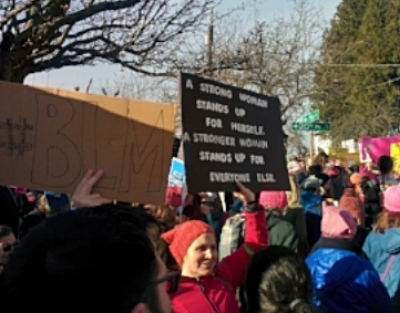

Trumpression: What One Interchangeable White Lady Felt After the Election

The results of election night cast a long, gloomy shadow across my household, my classroom, and my life the past month. Despite the influx of blog posts and Facebook activism, many people (white people *cough, cough) don’t seem to understand why this is a big deal. It’s not enough to point out that it’s concerning to have a leader with no experience in politics, no understanding of American government, or human rights. It’s an understatement to say that I’m angry that we’ve accepted a man who consistently demonstrates misogynistic, racist, xenophobic behaviors and ideals to be our president-elect (I’m not here to argue with you if you don’t agree with those labels).
As a woman his power concerns me because at best we now have a president with a cavalier attitude towards sexual assault who consistently objectifies women’s bodies while insulting their brains. At worst, I have a new president who will work to pass laws that continue to keep me paid poorly and take away my reproductive rights.
As a white woman who cares about my family, I fear for the future of the people I fiercely love--my husband, my brother-in-law, my sister-in-law, my biracial nieces and nephews,many of my close friends, and certainly my students. As a white woman who cares about intersectionality, I believe that “an injustice to one is an injustice to all”. More than ever those of us with societal capital must wake up and use our privileges to fight for those whose rights are threatened or increasingly under attack.
So when I thought about our future and looked out across the sea of black, brown, beige, and white faces the day after the election, I felt panic. I felt fear. I felt rage. And...I felt hopelessness. I suppose I maybe kind sorta feel a tiny bit of the daily terror that many people of color, many LGBQT, or religious minorities face EVERY SINGLE DAY.
I just couldn’t follow the advice of all the well-meaning articles. Tell your students you’ll keep them safe. I can’t keep them safe from being deported. I can’t keep a kid safe when someone is spitting on him or calling him the N-word. Tell your students that many people are frustrated by the economy. Yes, because despite his approval ratings, Obama may actually be the president who actually positively impacted. I think not. I found some solace and support in the advice from Teaching Tolerance, including being honest with your students about potential impact of race and class in society. In the following weeks, I’ve pulled myself off the couch, thrown away the tub of ice cream, tossed my shoulders back and faced my students. I’m embarrassed to admit how much Dave Chapelle, Chris Rock, and SNL nailed it with their election night skit. I don’t feel hopeful, but I do feel resolved.
Now, more than ever white women--especially white educators--need to grow some ovaries and be the allies we know we can be and we need to be. Clearly, we've got some serious problems manifested in the 52-62% of “us” who voted for Trump (that's a blog post for another day). For now, we need to examine our privileges and use what status or voice that provides.
Allyship looks different in 2016 than it did twenty years ago. We need to look to the past for courage but look at the present for direction. There’s a place for marching. There’s a place for demonstrating. There’s a place for donating that hard earned cash to an organization reaching a community I don’t have access to.
In the classroom, I’m determined more than ever to challenge myself to be a culturally responsive ally, who embraces the interchangeable white lady challenge and equips my students to the best of my ability. I regularly ask myself the following questions:
Is my classroom a space where all my students feel safe? Are students reading about contemporary issues that matter in their lives? Are my students practicing seeing from different points of view? Are we sugarcoating world problems or exploring their complexities and solutions? How am I developing empathy across racial and cultural differences in my classroom?Am I practicing what I preach?

Goals for a New School Year: #ObserveMe
Note: I started this site for more personal musings on education but I also write for the Stories from Schools blog. Here is an excerpt of a recent post on my goals for the upcoming school year.

I first spotted the #ObserveMe hashtag on a leisurely scroll through my Twitter feed. This piqued my curiosity. Who’s observing me? What are they observing? As I spiraled down the internet, I found that Math teacher, Robert Kaplinsky, is challenging educators to rethink the way we pursue feedback by making it easy and immediately obtainable. It’s simple. Make a form that says something like “Hi I’m ____. I would like feedback on the following goals:_____”. There is no right way to set up your #ObserveMe sign. Then, adjacent to this invite place a reflection tool. From reflection half-sheets to QR codes connected to google spreadsheets, a teacher can embrace any way that is easy (and I’d argue most meaningful) for them to receive this feedback.
I discovered that while #ObserveMe isn’t quite trending yet, it’s catching fire even at the university level. In teacher prep, some professors are using it as a way to model to preservice teachers the need for a clean feedback loop. Today's teachers are constantly working to fight the isolation that can happen in this profession. We are also always looking for ways to improve and receiving meaningful feedback on our instructional moves is hard to find. Here’s what I like about Kaplinsky’s challenge to teachers.
It increases the frequency of feedback. With #ObserveMe, I don’t need to wait for my administrator’s scheduled visit. I don’t need to wait for end of unit or end of course student reflections. I don’t need to wait for my instructional coach to find time to come into my classroom. I don’t need to wait for a colleague to get a sub so they can meet with me about student learning. In fact, this has the potential to give me more, real, immediate feedback from a variety of perspectives than anything I’ve seen this far in my eleven years of teaching.
For more click here.
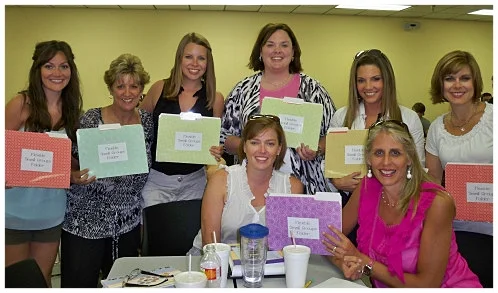
The Interchangeable White Lady: An Introduction

I don’t know where I first heard the term “interchangeable white lady”. It might have been in a text I read in graduate school or maybe one of my colleagues let it drop during a discussion on cultural competency. Regardless, I remember nodding and laughing as I pictured a smiling, 20-something in her Target cardigan standing in front of a Smartboard. Subsequently, I shook my head thinking about being a young Black or Brown boy who went throughout his day staring at the “same” face over and over and over again.
I was a little surprised to later learn that this term left some of my teaching peers with a bad taste in their mouths. It held a negative connotation, was weighted with unspoken questions, and bred a sense of resentment.
I’m not a robot. I’m not like all those other women. I’m unique. Why am I being judged by my skin color? Why am I being dismissed because of how I look? Shouldn’t we be treated as individuals? I’ve struggled too! Isn’t it racist to think we all look the same? Isn’t it prejudice to hate me and my class even before I’ve started teaching?
WELCOME TO BEING A PERSON OF COLOR IN AMERICA--ENJOY YOUR BRIEF STAY.
Seriously though, if you’ve ever had those thoughts, I’d like to challenge you to reconsider that this phrase “interchangeable white lady” isn’t offensive, it captures a reality.
It captures the day in and day out grind that many students of color experience moving from English to History to Science and throughout their school day. This reality should shape the way that we teach and the way that we prepare new young, white, and female teachers coming into the profession. It also has the potential to shape how we approach hiring qualified and diversified staff.
For me, the term “interchangeable white lady” identifies what I see in the eyes of many of my students at the start of the school year. It is a name they will likely never call me directly but I can see it in that dull stare...and I hope to change their perspective over the course of the year.
I became an interchangeable white lady back in ‘06. A recent Master in Teaching graduate, at 24 with an endorsement in Language Arts, I was one of many on the market, looking for a teaching job. On the outside I appeared to be the same as anyone else. Young. Middle Class. And White. I shopped at the typical white lady teacher stores (you know--Target, Kohls, and Banana Republic). That first day of teaching I was scared--was I prepared? Did I have a strong lesson? Would students respect me? Would students like me (yeah, we all say that doesn’t matter but sometimes it does)? My 9th graders were equally afraid--but for each of them, my presence represented something different. I was both loved and hated by my students. I was too mean. I was too soft. I wore ugly Danskos.
The most significant part of realizing that I was an interchangeable white lady was realizing that student perception drives everything. It didn’t really matter if their perceptions are true. It’s their truth and it shapes whether or not they will learn from you.
New teachers, especially those who are white and female, must come to grips with the fact that they will be perceived as the literal shining face of a system that marginalizes many students, particularly students of color. Effective teacher prep programs or relevant new teacher induction programs should help these teachers explore their own racial and cultural identities so that they are starting from a place of empathy for the experiences of their students before establishing their classroom expectations and routines.
I was fortunate to learn from some of the best in teacher prep at The Evergreen State College (SHOUT OUT!). This program is rooted in understanding the history of American public education. I spent hours and hours reading and writing about identity formation, and specifically explored my own social, cultural, and historical identities. This prepared me to table my own values around education and work ethic, and to focus on building relationships with my students.
When we--interchangeable white women--enter the teaching profession, particularly if we plan to teach to an ever Brown-er student population, we must seek to understand at least some of the complicated dynamics of our teaching context. And that means, wrapping our heads around the fact that we will be perceived as “them”. That means letting go of the “right” to be perceived as original, unique, or individual. That means facing the unflattering ways we may be perceived by our students...and then doing something about it.
Being an “interchangeable white lady” is a beautiful challenge.
It’s a challenge to teach in a culturally responsive way based on the students before us.
My girl Emily highlights her identity as an athlete-scholar, using the Oregon Ducks to teach Geometry. Sara sings her way through quadratic equations and derivatives in order to get students to think like mathematicians. Through vocabulary competitions, Cheryl creates a common nerd culture that students buy into. Mary transforms her library into a space where students of all cultures, races, and languages can find a book that reflects their uniques selves.
It’s a challenge to view our instruction through the lens of traditionally marginalized youth.
Kim devours book after book after book to help her better identify with her students. Monique has students complete perception surveys, sharing how they feel about the class and giving suggestions for what they want to study--and then she goes out and finds readings based on these interests. Jenny uses her Southern charm and resolute determination to win over the most reluctant learner to the magic of Physics. Alissa applies for grant after grant in order to fund special field trips, buy cultural foods or invite guest speakers to make her Spanish class come alive.
It’s a challenge to distinguish ourselves as allies in the fight against institutional racism as we equip young men and women through the power of education.
Sarah loudly demands that her most needy ELL students be scheduled with the most effective teachers. Paige sweats over curriculum to ensure that students are getting the best instructional moves possible and that their voices are a prominent part of each lesson. Cat defended an African-American, special education student who was being physically and verbally abused by a police officer on school grounds.
Being confused for any one of those women is a compliment. If a young man or young woman of color sees me as interchangeable with a less proficient teacher, that’s fine too. I take that as a challenge to step up my game.
And that’s why I’m okay with being an “interchangeable white lady”.